Your English Isn't as Weak as You Think — Start With One Simple Book

You don't have weak English — you picked the wrong first book. Your school vocabulary is enough for a simple one; finish it and let momentum carry you.
Translated from the original Chinese and reviewed by the author. Read the original (Chinese)
Happy Dragon Boat Festival, everyone! (It's a holiday weekend here in China.)
Nothing about building a product beats a moment like this.
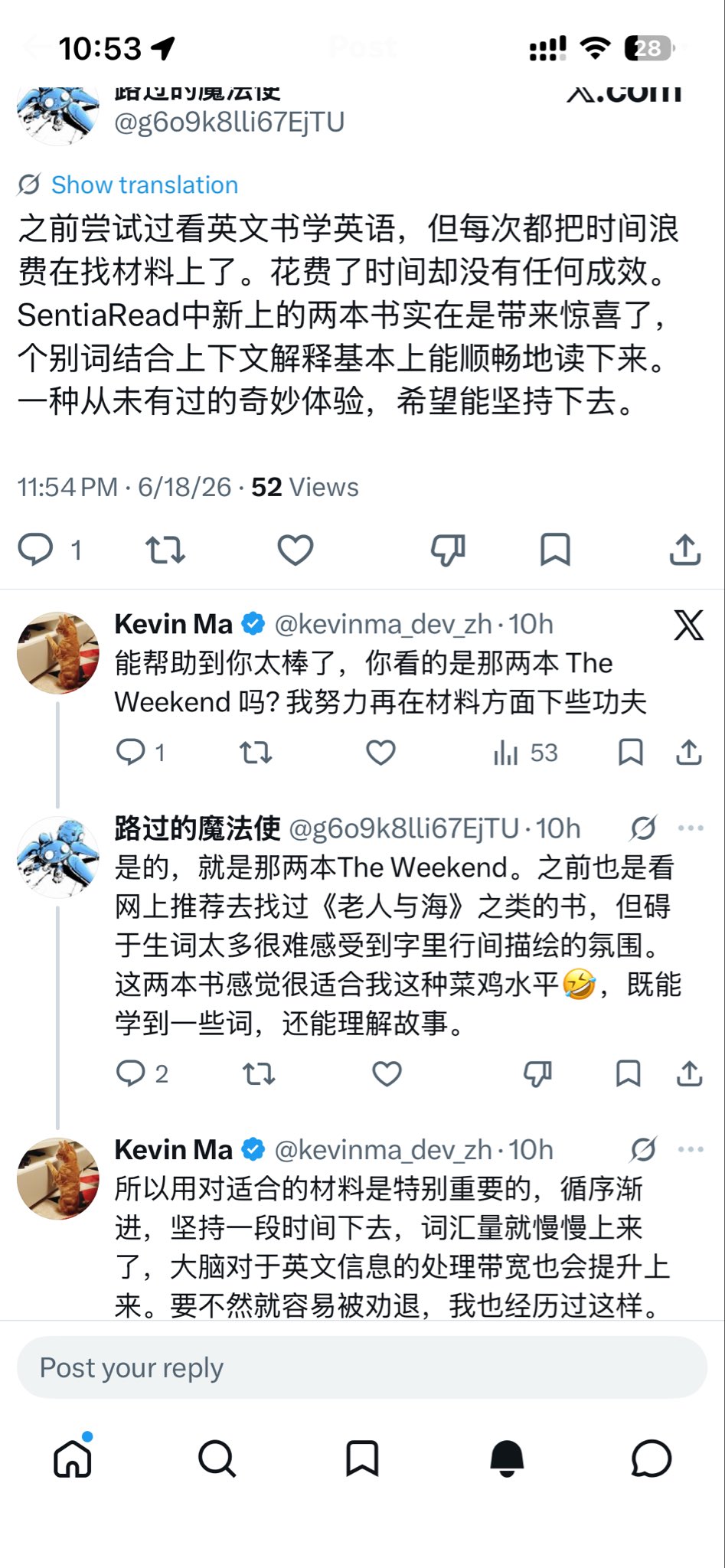
Yesterday I published a post about learning English. The whole point fit in one sentence: stop hunting for the best method, just start (see Stop Looking for the 'Best Way' to Learn English. Just Start.). And speaking of starting, that same day I got a comment from a reader on X that I really wanted to share.
Here's roughly what he said: he'd tried reading English books to learn English before, but every time he ended up wasting his time hunting for materials, putting in hours with little to show for it. This time he tried the two new books in SentiaRead. The occasional unknown word clicked from context with a single tap, and he could basically read straight through — a kind of experience he'd never had before. He hoped he could keep it up.
I asked which two books. He said the two The Weekend books in SentiaRead. Then he added something that stuck with me: following recommendations he'd seen online, he had gone out of his way to read "classics" like The Old Man and the Sea — but there were so many unknown words he couldn't feel the story between the lines at all, and he gave up after two pages. These two, though, "felt just right for a rookie like me": he picked up some words along the way and actually understood the story.
He's not the first to say this
Honestly, the comment didn't surprise me much, because he isn't the first person to tell me this.
Several users have described almost exactly the same experience: they thought their English was very basic and had little confidence, but the first time they finished one or two English ebooks cover to cover, the sense of achievement was real — something they had never felt before.
The interesting part is that they all got stuck at the same place. It wasn't that they "couldn't read English" — it was that they picked the wrong material from day one. They'd heard that "reading the originals works best," went straight for The Old Man and the Sea or The Great Gatsby, got buried in unknown words, and walked away with the wrong conclusion: "I guess my English still isn't good enough."
It's not that you're not good enough. You skipped too many levels.
Your "exam English" is a better foundation than you think
My generation learned English the test-prep way, from middle school through college: good at exercises, unable to open our mouths. Painful to learn, nothing to feel proud of. If that sounds like your schooling too, chances are you seriously underestimate your own English.
But think about it calmly: all those years of memorized words and reading-comprehension drills quietly built you a vocabulary base that isn't small at all. It's not enough to read the classics straight away — but it's plenty for a simple book at the right level.
The problem was never a "weak foundation." It's that nobody told you: start with simple, easy material.
Fairy tales, fables, adapted graded readers, short stories with straightforward plots — things like The Wonderful Wizard of Oz, Aesop's Fables, Grimms' Fairy Tales, The Secret Garden. Easy words, stories that still pull you in. Start there, and you can actually keep up.
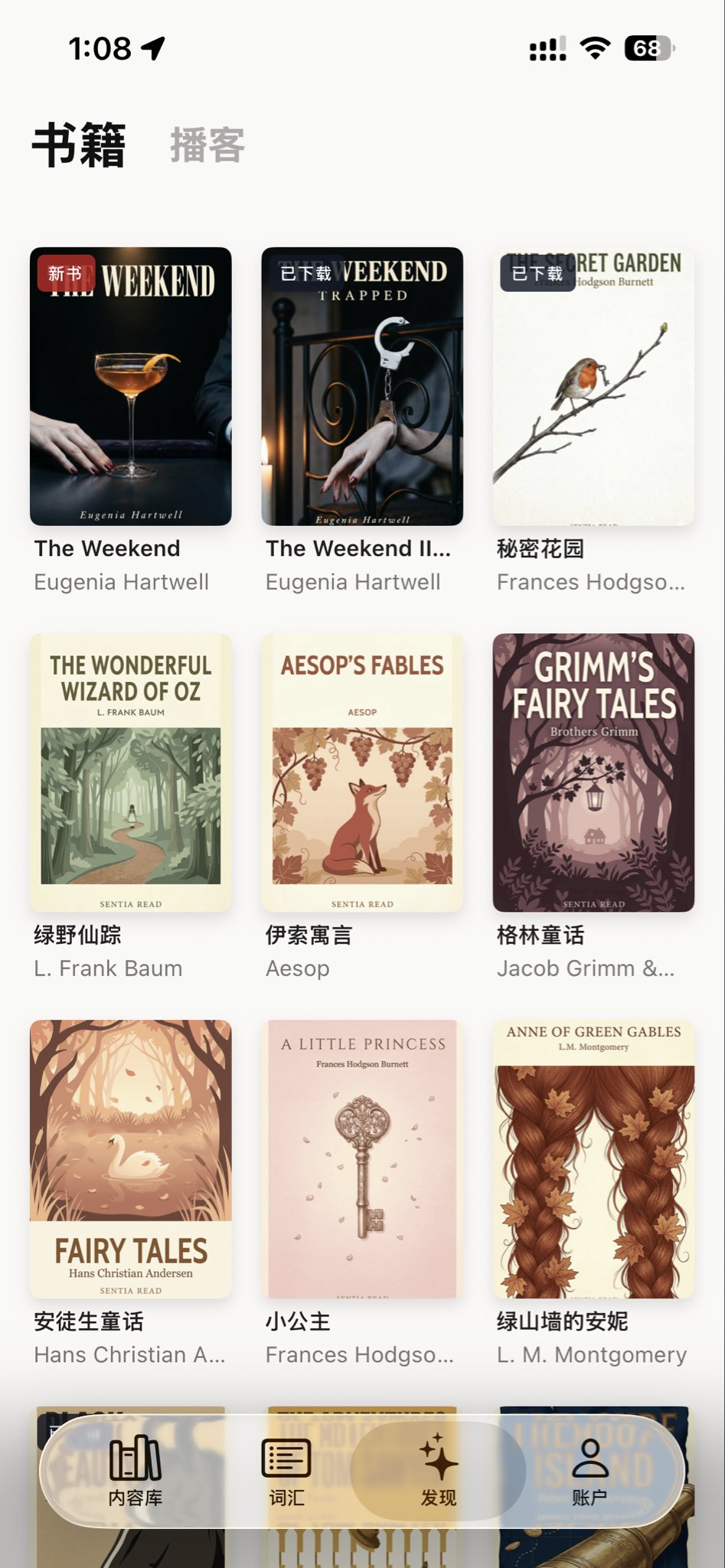
If you seriously want to restart but worry your base is too weak, my top recommendation is to begin with the two The Weekend books — the same two that reader on X read. They're written specifically for beginners: simple words, short sentences, but the stories are modern, everyday life with a bit of suspense — not dry textbook passages. The first book, The Weekend, opens with a married woman getting curious about a "date" outside her marriage; the second, The Weekend II: Trapped, pushes on into thriller territory and keeps you turning pages. Compared with the somewhat dated English of the public-domain classics, they read smoother and more contemporary — the easiest way to land your "first English book read cover to cover."
What really hooks you is the moment of "I actually understood that"
Start with the right material and something subtle happens.
At some point mid-page you suddenly notice: you just read that passage in English. And you understood the plot directly — not by translating each sentence into your native language in your head, but by understanding the content in English itself.
That's when the sense of achievement kicks in. And achievement compounds — it pushes you toward the next page, the next chapter, and the next book after this one. Sticking with it stops being hard once it shifts from "forcing yourself" to "being pulled along by the story."
From there it's a positive loop: the longer you keep going, the more your vocabulary grows, and the wider your brain's "bandwidth" for processing English becomes. Reading gets easier, you can read more things, the sense of achievement gets stronger — and around it goes. Until one day you notice that reading English has become a perfectly ordinary part of your day, as natural as scrolling your phone.
To keep going, read what genuinely interests you
To get this compounding machine running, picking the right material is key. And there are really only two criteria: the right difficulty, and — more important — something you're genuinely interested in.
Difficulty I've covered: start with simple beginner material and don't skip levels. But interest matters even more, because interest is just about the only thing that keeps you going. So don't grind through the books you "should" read — read what you actually want to read: novels in a genre you love, English news in a field you follow, even work-related articles in your profession. That you're willing to keep turning the pages matters far more than whether the material is "classic enough."
One small habit while reading: when you hit an unknown word, don't rush to look it up. Guess a rough meaning from context, and keep going if you can. If a word keeps showing up (a high-frequency word), it matters — look it up then, and make a point of remembering it. The low-frequency words that appear only once or twice? Let them go; read enough and you'll meet them again anyway. This way you're not interrupted every two lines and you stay soaked in the story — that kind of immersive, high-volume reading is what actually makes English grow into you.
As for the few words you do decide to look up — making that fast without breaking your reading is a job for your tools.
Cut the friction of starting to a minimum
Why do so many people get stuck at "finding materials"? Because reading in English carries a lot of friction: it's hard to judge difficulty, looking up words is a hassle, and by the time you've looked one up you've lost the thread. Stack that friction up and it's enough to keep someone from ever starting.
That's why I built SentiaRead — to cut the friction of getting started as far down as possible.
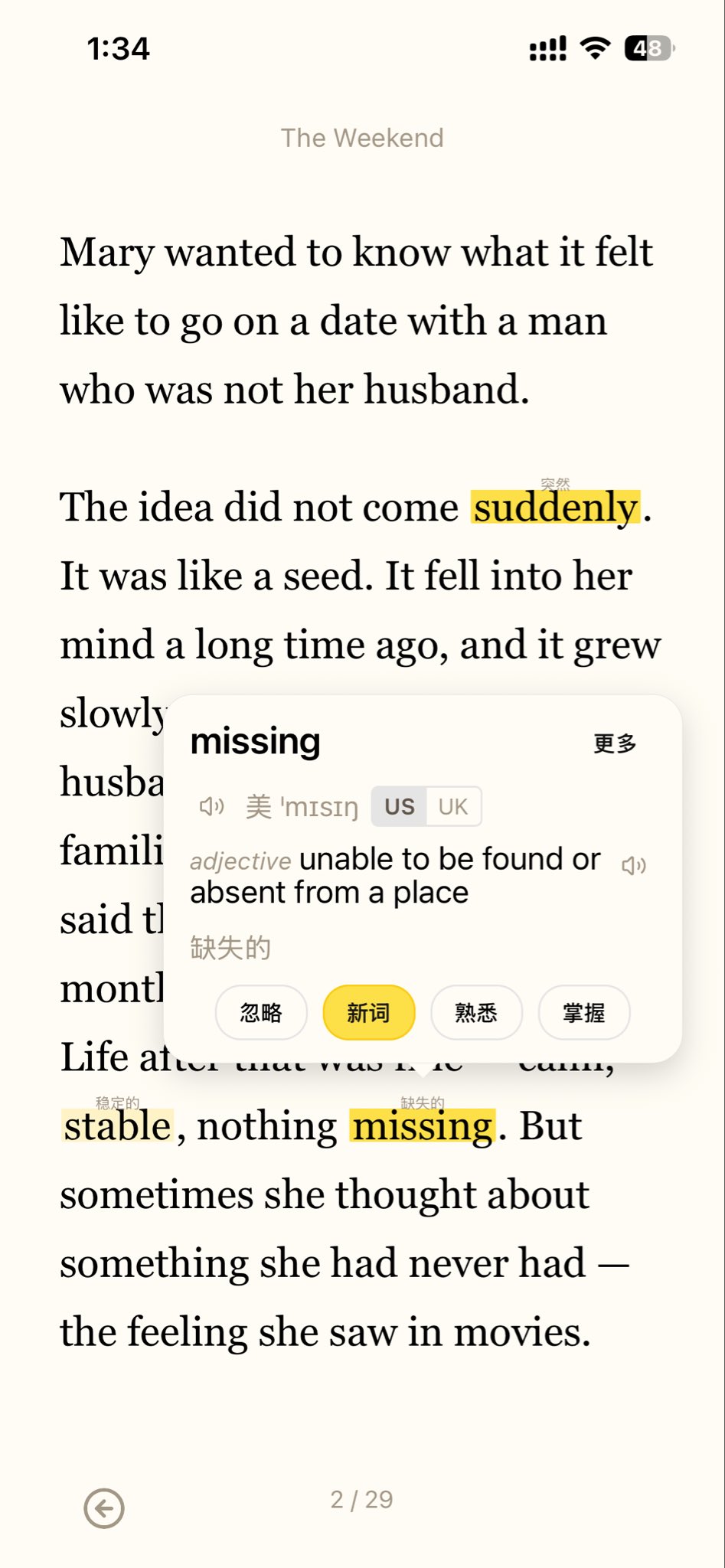
It comes with a set of lower-difficulty English books, so you can pick one and start reading today — no more hunting for materials. And when you do want to understand a word, one tap: the AI reads the context of that sentence and, matched to your level, gives you just the one meaning that fits here. No switching out to a dictionary, no guessing among a pile of definitions — you look it up and keep reading right away. With less friction, both starting and sticking with it get easier.
If you want to pick English back up and find out, one more time, whether you can actually stick with it — give it a try.
You can download it at https://sentiaread.com — it runs on Android, iOS, macOS, Windows, as a browser extension, and on e-ink devices — pretty much every platform.
Don't let "my English is too weak" talk you out of it. If you've got some free time over the holiday, pick a simple book and read for ten minutes. Odds are you'll get through it.